Fake news and information literacy
[caption id="" align=“alignleft” width=“300”]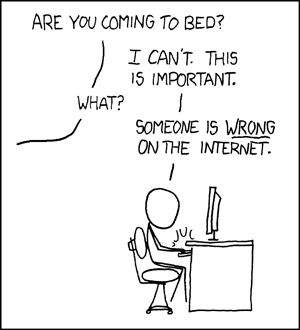 Randall Munroe, “Duty Calls,” xkcd webcomic. https://xkcd.com/386/ https://creativecommons.org/licenses/by-nc/2.5/[/caption]
In the wake of the presidential election of 2016, a key concern has been the spreading of fake news, especially via social media. A study conducted by the Stanford History Education Group on online media literacy at middle school, high school and college levels has been widely cited in response to concerns about fake news. This study found that students at all levels are underprepared to identify misleading information online and to effectively make cases about its trustworthiness. A recent Pew Research Center poll indicated that a majority of Americans are very or somewhat confident in their ability to recognize fake news stories – but that hasn’t seemed to stop the spread of problematic information.
While Facebook and other social media sites consider what measures they can and should take to identify fake news or to curtail the sharing of fake news sites, and advertisers contemplate how to pull their ads from networks that serve such sites, individuals might ask, how can I know that a source is trustworthy?
Established fact-checking websites like snopes.com, politifact.com, and factcheck.org may be helpful in some instances, but often the evaluation of information comes down to making as solid a decision as possible about the credibility of its source and transparency of its intentions.
There are several checklists that provide suggestions for evaluating information. The CRAAP test developed by librarians at California State University, Chico, suggests considering information using the categories of:
- Currency (the timeliness of the information),
- Relevance (the importance of the information for your needs),
- Authority (the source of the information),
- Accuracy (the reliability, truthfulness and correctness of the content), and
- Purpose (the reason the information exists).
- Source (Who is providing the information?),
- Motivation (Why are they telling me this?),
- Evidence (What evidence is provided for generalizations?),
- Logic (Do the facts logically compel the conclusions?) and
- Left out (What’s missing that might change our interpretation of the information?).
Penrose librarians are happy to answer questions and to develop lessons related to these information literacy issues for specific classes. Students can also register for Library courses this semester on Information Literacy (Library 100) and Primary Sources (Library 300), which address choosing appropriate sources for research in scholarly settings.